Saturday, 8 July 2023

Silverburn to Barrhead. The Magic Kingdom Trail. Part One.

                                                  ALL PHOTOS CLICK FULL SCREEN


Buchanan Bus Station. When I was doing my other Pollok Walk from Silverburn to Paisley via Dkyebar, posted on here several months ago, I had the idea to follow the Brock Burn from Pollok upstream to the Barrhead Uplands as I knew a network of paths would make it easy yet very scenic. It's a walk best suited to public transport, bus or train, as it has a different start and end point and parking is limited or non existent anyway. 


 Fortunately, the number X8 bus is an express leaving from Buchanan Bus Station and apart from a few streets of city centre traffic it's straight onto the motorway after Bothwell Street and 15 mins later you are in Silverburn Shopping Centre in the middle of Pollok. Very fast. Which was a considerable bonus.


Silverburn Shopping Centre.


The path along the right hand bank of the Brock Burn starts to the right of this Cineworld signage directly under this 10 foot high brown statue and runs around the edge of the housing scheme of Priesthill. Supposedly, once upon a time, a priest was murdered here, giving his rank/title to the area if not his actual name, which apparently no one thought to ask him for before his sudden demise.  Many centuries later, again once upon a time, back in the 1980s, it looked like this. Story book time.


Streets lined with flat roofed 1950s style council built tenements, many of them starting to become empty at that point although the eventual demolition in all the large Glasgow estates of run down tenement clusters would take decades to achieve. Half the population would also vanish in a puff of smoke as throughout the 1980s thousands of Scottish jobs simply disappeared as the UK changed from country wide factories, shipyards and heavy industry to become the London and the South East centrist service and banking hub that it still is today. Instigated by the Wicked Witch of capitalist idealism and her flying monkeys, starting in 1979 to the early 1990s which laid waste to the north as devastating and long lasting as any fiery furnace dragon's breath.


It now looks similar to this... low level back and front garden cottage types, many owner occupied. Urban living but surrounded by woods and meadows. Mind you, I don't think today's children explore their surroundings like we did. We had virtually nothing indoors to amuse us in the 1960s and practically lived outside except for meals and sleeping whereas they now have loads of gadgets and computers to entertain them. And an increased modern awareness/ acceptance that any stranger encountered outside may well be a pervert- something that never occurred to us unless said stranger started acted funny. In which case  we could run.... or fight.


Priesthill Road in 2023.  A perfectly pleasant place to live now.


Which makes it strange that shopping trolleys are still being dumped here. I always knew that Silverburn Shopping Centre was so named due to the number of shopping trolleys dumped in the Brock Burn since the 1980s  and glinting there year round in the water but I had no idea it would still be happening... or why? Obviously people get their messages, take them home without a car, then dump the empty trolley afterwards but to have this once notorious estate completely transformed for the better but find this still occurring in 2023. is extraordinary. And a puzzle. The power of ritual!?


I counted around 40 at a guess, either in the stream or sitting on the bank in this small area.


Just some more human waste that nature attempts to hide along with the millions of other throwaway rubbish items that nature has to conceal every year. This stretch is short lived however and you soon leave it behind.... so worry not.


The Brock Burn walkway at Silverburn. It is a nice walkway or bike trail and in May or June is covered in wild flowers.


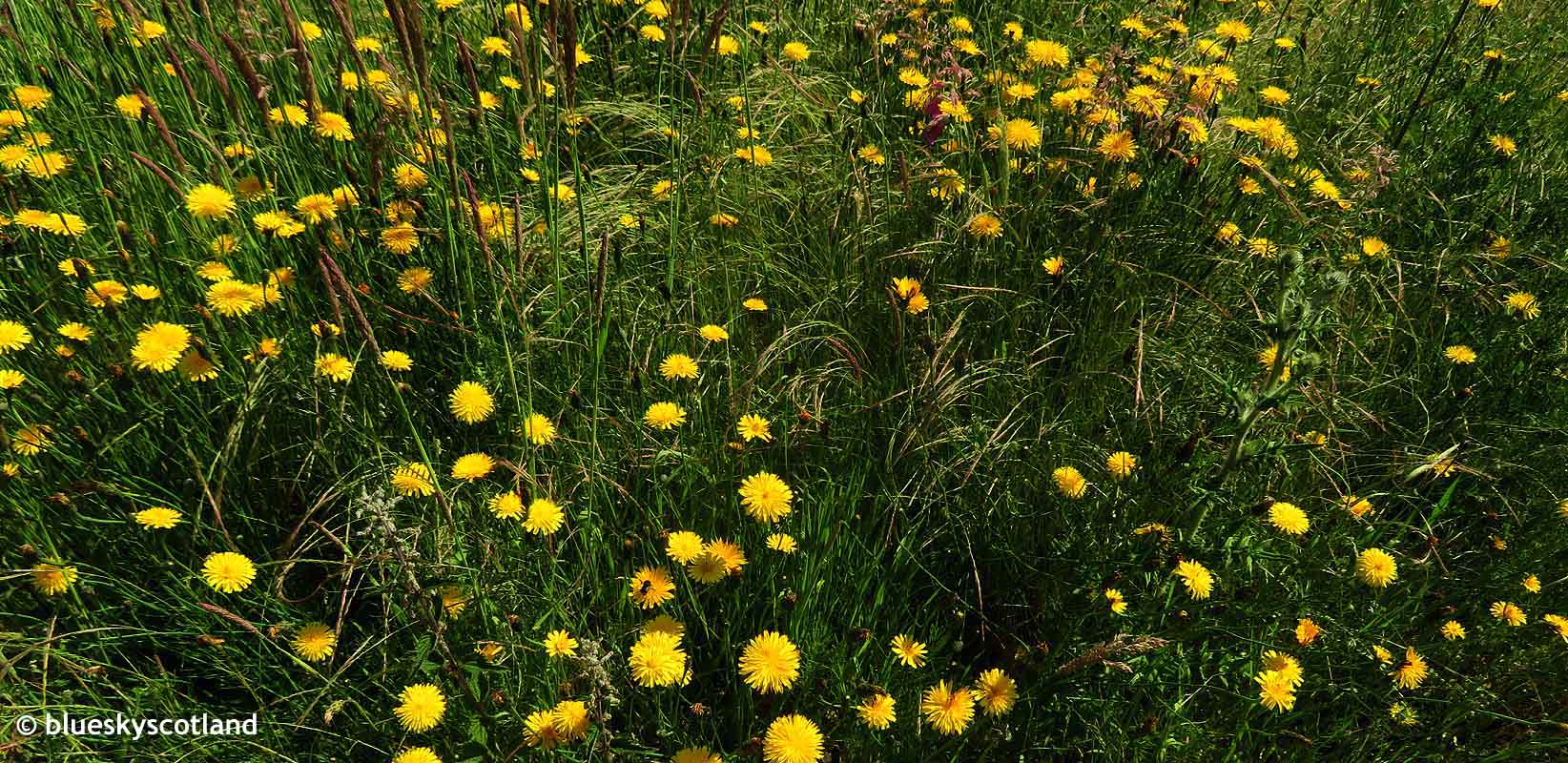
Grass verge wild flowers.


Cow parsley on the Brock Burn Walkway.


I took a quick optional detour up Glenmuir Drive in Priesthill, seen here, to view the wild hilltop where flat roofed 1950s tenements and a square concrete water tower once stood up until the 1990s.... now home to small trees, a meadow, and reclaimed scrub land. All houses removed


This is it here.


I was glad I did this as I took this photo from the summit slopes in May 2023 looking south across the few remaining modernized tenements on South Nitshill with the full glory of Renfrewshire beyond. If you grow up here and you enjoy the outdoor life, this magical landscape is a real gift. It was a gift then back in the 1960s and it still is today. Vivid and extraordinary. Even now I feel the power of this view... for exploration possibilities. As a child this was right on my doorstep. Every day. 

I started life in inner city Glasgow... Kinning Park and Cessnock, packed streets of heavily built up urban districts with very little in the way of trees or greenery yet moved out to leafy Pollok just after I learned to walk. It was and still is a paradise. You can walk from here to the sea 40 to 50 miles away and all you will pass will be farms, countless dams and ponds. rural streams, meadows, woods, waterfalls, hills and hollows. And I did explore it, every free weekend and holiday day off for over 20 years.


Brownside Braes and the town of Barrhead. I've travelled all over the UK and this area is unique in Scotland. This crumpled bedspread landscape of small hills, woods, numerous dams, drumlins, streams, heights and hollows occurs nowhere else and has much more in common with Southern English hill ranges like The Cotswolds, The Malvern Hills, The Weald etc than the rest of Scotland.... and the Gleniffer Braes/Brownside Braes/ Fereneze Hills/Lochliboside Hills, (all connected together and all under 1000 foot) have a lush cornucopia of summer vegetation that the higher slopes of The Campsies, The Kilpatricks, and The Fintry hills simply cannot match. This far north an extra 500 foot in height matters and the last three hill ranges mentioned, also surrounding Glasgow, are very bleak by comparison, mostly treeless, wind exposed, and shelter-less on top, apart from conifers. Bearing in mind we often left the house in the 1960s as children to go exploring here without a warm jacket, no rucksack, no food, no water bottle, poor footwear etc.... so anything too extreme, harsh, or bad weather was a definite low point to our mood and severe hindrance to staying out longer, once we got cold, wet or hungry. Rain showers we could avoid in the numerous small woods in this area so only a full day of heavy rain put us off going out into our surroundings. 


A vibrant lilac bush in Priesthill.


Dappled shade along the Brock Burn walkway.


The Brock Burn path comes out at Darnley on Kennishead Road and another green path starts a stones throw to the left of it, using another green band of empty land  running between Arden and the A77.


Back in the 1980s all of the Darnley council estate used to look like this, a high level deck access scheme, but only this one long block remains of that to give you some idea of what the rest used to look like. Now, like most of the other large ex-council estates in Glasgow it's low level properties in the main, some owner occupied or rented. See previous photo one up for that.


I came out at Darnley Mill on Nitshill Road which up until the 1970s used to be a working dairy farm, with herds of black and white cattle grazing the surrounding fields.( fields I played happily in for over a decade or more which are now buried under various owner occupied housing estates in this vicinity) Then it became a restaurant for many years... and now it's a medical practice named after the famous Darnley Sycamore tree just across the road from it.


The famous Glasgow sycamore of that ilk. Of Lord Darnley and Mary Queen of Scots fame.


Built around 1958 this was the estate of South Nitshill by the mid 1960s.


By the 1990s it was mostly empty and scheduled for demolition.


But for me the real beauty of this place was always the surrounding landscapes and I developed a deep affection for small woods, meadows, stunning rolling countryside and cattle. When you are eight years old cows are the size of elephants so we treated them with the ease of gradual familiarity but also with awe and respect. We would wander through fields with cattle in them no problem but we always had a quick escape route sussed out just in case, through a gap in hedge or fence. Occasionally a bull was present, not always in plain view. Luckily, it was a rural landscape that you could and still can wander through....mostly without boundaries. Not all farmland is like that.


'How green was my valley' summed up what I loved most about this place. South Nitshill, looking west. Excellent walking in that direction as well. In every direction in fact.


And the next section is even better. The Magic Kingdom indeed. Part One.
 

Friday, 30 June 2023

A Nautical Experience. Port Glasgow. Sugar Boat. Ardmore Peninsula. Firth of Clyde.

                                                     ALL PHOTOS CLICK FULL SCREEN.


Just by chance I got back in touch with an old friend, Alan, a few weeks ago and we've been away walking a few times since then. We used to go hill- walking and kayaking together but since that time he's acquired a boat and engine. He also expressed an interest to visit the MV Captayannis, a 400 foot long metal island sitting in the Firth of Clyde between Greenock and Helensburgh.  A Greek owned merchant ship carrying a hold full of sugar for the Greenock based Tate and Lyle sugar factory it was moored at anchor when a violent storm blew in. The sugar boat anchor came loose and it drifted away, becoming holed under the water by the anchor line of a tanker so the captain, knowing a large sandbank lay close by, beached it there and all the crew and captain got rescued safely. It's been there since that happened in 1974 as a dispute with ownership, titles, etc means that no-one has been willing to claim  responsibility for it.... or meet its removal costs.  Although clearly visible at low tide from the mainland, (if you know where to look for it that is and realise what it is you are looking at,) unless you are into watersports and sailing craft it's not that well known... or reachable. ( I only found out tonight, looking it up, that it's supposedly Greenock's greatest attraction but I'd dispute that...  the  architectural gem of Victoria Tower and the ornate council buildings beneath it being my own personal favourite on land. Or 'The Cut' walk running above Greenock along the vintage water filled lade, fresh water being directed along a long channel from Loch Thom to provide drinking and industry liquid to that town in former times. Or the walking/bike trails on the various hillsides above the three towns.

By fast tour boat RIB from Greenock you can visit it in an hour round trip from around £20 per person and I have visited it over ten years ago on a friend's boat, a big powerful RIB. That was a memorable trip but this was even more memorable and very vivid in a smaller slower boat... as there was considerably more doubt on my part that we would reach it at all, this time, given that it sits a long way out in the middle of the Firth Of Clyde, a full 7 km ( 4.3 miles) from our start point near Newark Castle, seen here. But as Alan is usually up for most of my ideas it was only fair I had a go at his. It was mainly his idea to kayak down the River Clyde and up the White Cart Water years ago, paddling directly under the busy shopping streets of Paisley via a series of dark, concealed water tunnels, something few folk in Scotland have ever done. ( Do not fall in!)


One of the things I've always liked about Alan though, (unlike most hill-walkers and outdoor folk that I've met over the decades), is that he's not blinkered to one activity. In my experience of various clubs I've been in this is rare. Like me he's open to a wider range of outdoor pursuits. Mention to most hill-walkers, skiers, kayakers, bothiers etc something else... like a beach walk, a city walk, a history or art day out.... etc and they are not at all interested in trying anything other than what they do almost every weekend... year in year out. The good point is that he's usually receptive to any of my 'thinking out the box' ideas about where to visit.... The downside is he has 'thinking out the box' ideas of his own about where he wants to go as well. Damn.  :o)  ... and as he's usually open to things I suggest... it's only fair that I'm equally open to his ideas as well. Or try to be.......So...... Launch slip at Port Glasgow above. Trepidation and excitement in equal measure. The sugar boat is not even that speck in the distance in this photo above. It's the speck beyond that tiny speck in the distance ... once you reach that first tiny speck in the distance.,,, it's the next tiny speck in the distance after that.

It was an adventure though, and travelling at walking pace across the bounding seas we had plenty of time to take in our surroundings. Newark Castle here. It's been around five years or so since my last Port Glasgow/Greenock/ Gourock visit so it was interesting to see any changes.

 Ferguson Shipyard. where they are still building the two long awaited  new Scottish ferries.... several years delayed.

 Part of the town of Port Glasgow.... from a distance. 


The biggest surprise here is the recent addition of a pair of silver coloured shipyard workers with mighty hammers, 10 metres tall, 33 feet high by artist John McKenna, which should put Port Glasgow more on passing tourists radar. I've always liked these three towns for walking, climbing and exploring way back to the early 1970s so it's nice to see such a large and iconic sculpture being built right here in Port Glasgow.


 Running between this Port Glasgow and Greenock side of the River Clyde estuary is the deep water shipping channel with large tankers and other vessels up to 1000 foot long and many thousands of tons in weight passing by so we motored across it as fast as we could to reach the edge of the sandbank line. Most large rivers have sandbanks and The River Clyde is no exception with two large examples, Cockle Bank And Pillar Bank. At low tide I've walked out and explored Pillar Bank on foot from Dumbarton and also walked the coastline  between Helensburgh and Dumbarton several times so I had a good knowledge of this area and what to expect... as in... you could be a mile out to sea in The Firth of Clyde estuary yet sailing over six inches of water... or  twenty feet away hit 30 feet of depth. Which is why large ships normally have pilot boats to guide them up this complex upper river. Before dynamite work and various dredging improvements occurred over many decades only smaller boats could make it up the river all the way into Glasgow, the river being too shallow for trade so Port Glasgow was the main trading port for Glasgow over decades, reaping the benefit rewards, until the city reinvented itself as an industrial powerhouse, trading, and shipbuilding hub once the river was artificially deepened and straightened out. Before that small boats or vehicles travelling overland carried most goods into the city from the Port (of ) Glasgow. After that they concentrated on shipbuilding in this town, which could be boom or bust every few years, depending on contracts gained or lost to build ships. 


This is us riding the edge of the sandbar called Pillar Bank. Water six inches deep in places, where you could step out the boat,  despite being a mile out to sea.  Luckily, it was a calm sea despite a 15 mile an hour breeze and no large ships appeared. The water was clear below you, which helped greatly with navigation, weaving craftily across the sandbar via deeper thin channels carving into it.


The sugar boat is well beyond that and at our reduced speed it took a long time to reach it. This also gave us plenty of time to ponder just how far out into the Firth we were going but we had life jackets on and the plucky little engine did its job and stayed true.


 Most of the seabirds that call this wreck their home turf were off fishing so it was only a handful of cormorants drying their wings that we disturbed and they soon came back. It was also choppy out here. Bigger swell in evidence.


Imagine a seabird that's not waterproof and you have cormorants and shags. You can see here they do look like modern dinosaurs evolved


I think we were both quite glad when we reached this point as it was a definite highlight event... the mood and any nerves lightened a little as that meant we could get back towards dry land. Having decided to camp overnight somewhere, instead of returning back to Port Glasgow we headed across to the Ardmore Peninsula, a lollypop of land between Cardross annd Helensburgh. If we were discreet we could pitch two tents there in a small bay and not be noticed.


This is it. It was a beautiful day 25 degrees c, a slight steady breeze and sunny so no midges around.


Space for just two tents in the rocks. This is one.


Later on that evening I took this zoomed view of the sugar boat from my tent with hundreds of birds on it. Obviously a popular roost, safe from predators, unless some rats are still alive in the substructure.


There's also a scenic path round the peninsula. This is it.


Sea Pink and boat shoes. 


Looking towards Helensburgh.


What appeared to be a fire boat or boat fire practice drill, sending jets of water a hundred feet or more into the air.


We were definitely the bargain basement boat tour, always will be, and all the better for it, but in Greenock across the water we could see the big wallet variety. £600 to £1000 plus at a guess for a luxury cruise up the Scottish West Coast and the Norwegian Fjords, according to the 'where was it going' info I looked up online after reading the name of this cruise ship. 


On our return the next day we had a walk around a Port Glasgow housing estate. Hundreds of homes but only a handful of folk living there... and it's been that way for over a decade now as I took photos of this estate ten or more years ago, thinking it would be knocked down fairly quickly back then. Nope. Still here.


I remember this place in the 1970s and 1980s/1990s and it was lived in and well kept then. I really liked exploring all the old estates within the three towns, many now only a fading memory of exceptionally unique districts long departed and vanished so it's sad to see it like this.


By the looks of them many of the houses have been vandalized over the years ( though not as much as you'd expect) but in an age where people are desperate for new affordable housing it seems very strange that this entire estate is lying empty. To my untrained eye the stonework is sound and they could be done up and modernized. The main disadvantage being there's very little job opportunities in Port Glasgow if you do live there and you would need to commute into Glasgow. But that's less than an hour away by car or train.  Local church with a tree growing out of it in the distance. Meanwhile on a recent walk, new houses are going up in Glasgow and Bearsden, on the outskirts, being built on green belt farmland where no houses have ever been before, just green fields and pastures. Everyone it seems wants to live out in the countryside.... or at least have a clear green view of what's left of it. 


As usual nature brightens everything up. June bush swarming with honey bees here.


June weeds. Port Glasgow.


A very unusual weekend that could only have happened with Alan. A 'Thinking out the box' special from him.


but I'll admit I'm happy to be back on dry land.... no 3rd visit from me way out there to that lonely rusting hulk again. Twice is enough for this lifetime.


Victoria Tower. Greenock.  On the  boat trip back we were joined by several large dolphins, leaping out the water, racing along the leading edge of the sandbar, trying to spook fish out of hiding. It spooked me slightly at any rate. They looked bigger than the boat. A memorable sight. Killer whales have also been spotted here a couple of summers ago and I did not fancy meeting a pod of them, having recently read about them 'interacting' with small boats elsewhere. Apparently in certain areas they like 'playing' with the small boats, sometimes damaging them...perhaps no real malice intended but unnerving just the same.

 Ah, The sea! A wonderful thing... if you survive to tell the tale :o)