This post is a homage to several things. Firstly, Great Western Road. The longest, straightest and most beautiful entrance into Glasgow, Scotland's largest city. Appropriately, this starts at St Georges Cross, with the slaying of a dragon myth and an act of Parliament in the 1800s before travelling north west like an arrow past a corridor of ornate buildings, bridges, churches,stunning parks, towers of glass, sandstone and ambition to end at Anniesland. As there is already an existing post to this action packed early section, which is well worth a look before continuing, I've included the link here. Filled with a brief history of the road and several period photographs it's recommended reading for what comes next.
http://www.scotcities.com/westend/gwesternrd.htm

When any city grows at the rate Glasgow expanded during the industrial revolution nature is often a casualty but the next extension to occur to this great highway was nothing other than a utopian vision of heaven on earth. With the shadow of the First World War (1914-1918) still a recent memory, the garden suburb of Knightswood began to appear in the 1920s and 1930s on former farmlands peppered with denuded mining spoil heaps and small scale diggings although mostly it was still green and rural. Fashionable at the time these pleasant suburbs were in vogue across cities throughout Europe with Mosspark and Carnyne (both in Glasgow), prime examples. Knightswood however started at Anniesland and the great road snaking through this new estate of mainly low level, back and front garden, cottage type homes would be an extension of an already prestigious highway where Victorian and Edwardian society had always flocked to be seen in their pomp and splendour travelling up and down this golden road either by foot or horse drawn carriage. The garden cities and suburb movement started in the UK before spreading to the rest of the world, with the USA a particular convert to the idea on a grand scale.
http://en.wikipedia.org/wiki/Garden_city_movement
Great Western Road, seen here, free from the adjoining corridor of surrounding city buildings was an open plan affair with broad pavements lined with flowering trees of various types and a dual carriageway separated by a wide green strip planted with daffodils (a modern addition) and a range of woodland and orchard favourites picked to enhance their surroundings. Apple, plums and flowering cherry trees line this golden highway in such spectacular abundance from Anniesland Cross to Bowling,(a distance of seven miles) that if they were rearranged into a formal park they would rival any display of a similar size anywhere on the planet for variety and design. Hundreds of individual trees, consisting of many different varieties, must line this famous thoroughfare and every one of them is a hand picked gem.
In spring, drivers, bikers, cyclists, walkers and joggers must love travelling down this green corridor of scent, birdsong, butterflies, other insects and colour. An annual pink and white parade of blooms.
Even bus drivers must get a thrill when they reach this stretch of their journey across the city and are transported from the everyday into the surreal.

Knightswood itself is laid out over several modest hills boasting good views. Streets and roads in this sprawling district are usually named after heraldic emblems or figures of the past like Kestrel, Pikeman, Athelstane, Mace, Turret, Rampart, Baldric, Talisman and Thane. I often visited relatives here as a small boy and it felt a world away from the tenement estate I grew up in, as separate as the world of lords and servants from each other. Gardens here used to boast old fashioned cottage flowers, shrubs, and trees like Pretty Nancy, Dog Rose, Lupins, Sweet William, Sweet Peas, Pansies, Forget me not, Lilac, Willow, Apple, White beam, Rowan and Red Current. Many gardens had rhubarb patches,vegetable plots and old Anderson shelters in them, and hung on to these relics proudly for many decades after the Second World War and rationing ceased to be an important issue in their lives as they knew from bitter experience how easily it could happen again.

Bluebells, snowdrops, and crocuses were also favourite bulbs in many gardens here and the whole of Knightswood seemed to revolve and breathe in and out with the seasons in those days. A honeyed land of tree lined boulevards, cooing pigeons, falling crab apples, conkers, ripe berries, and leafy corners to explore.... it certainly created a big impression on me that has lasted to this day.
The nearby Forth and Clyde canal, built in 1790, which snakes through the district parallel to the Great Western Road, a stones throw away, is a wildlife corridor, a walking and cycling jewel, but has also proved a magnet and hazard for generations of inquisitive children, many of whom have come to grief here in an annual ritual that is as ancient as its construction. Sleep well 'Ophelia'. A fallen petal that sank in the 60s, still remembered.
Another view of the road near the Drumchapel flyover.
The unusual curved hi rise flats near Blairdardie.
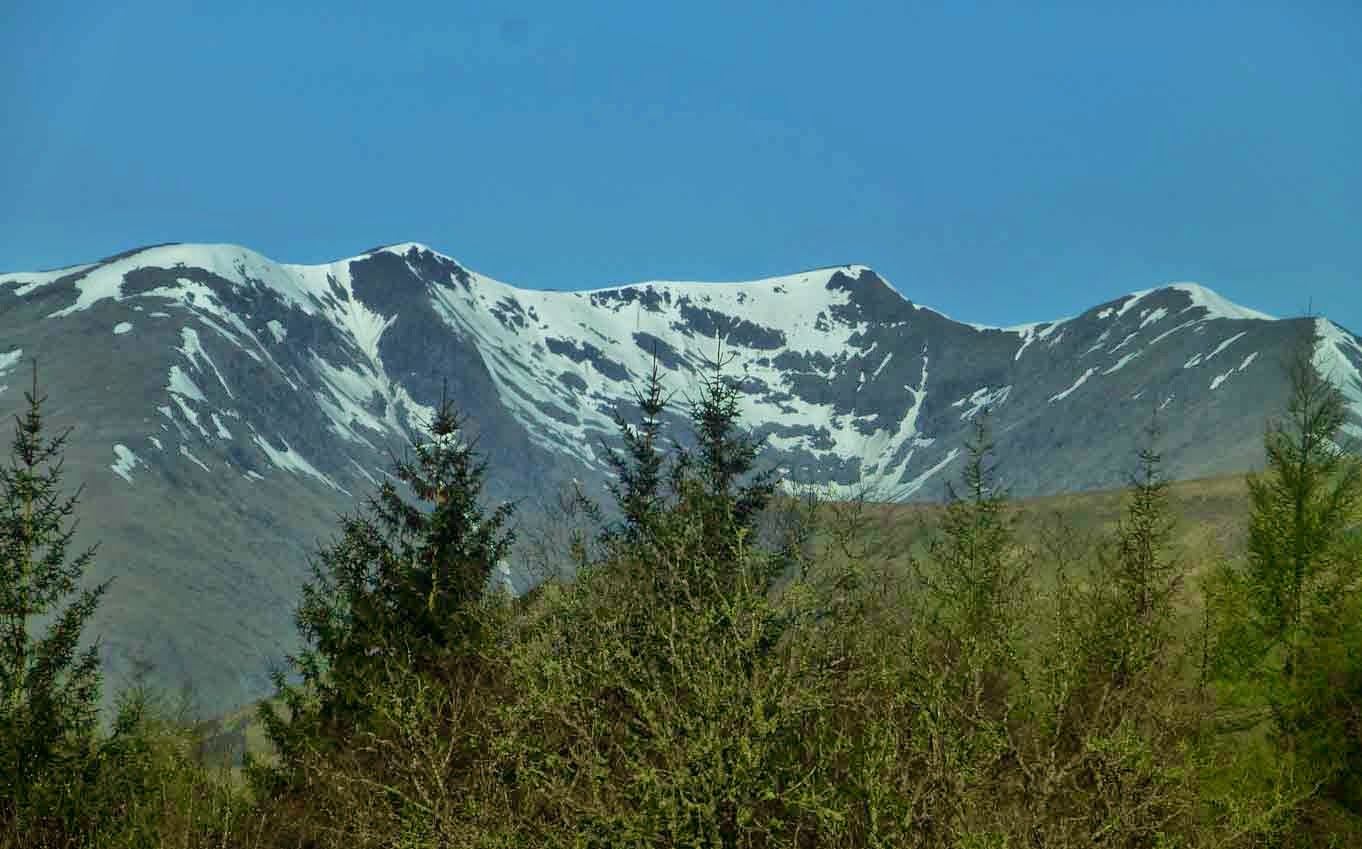
A distant view of the Kilpatrick Hills from the cherry tree bedecked highway near the Lincoln Inn Pub.
The Golden Highway at its finest. Glasgow's very own 'yellow brick road.
The high rise flats seen from Knightswood Cross.
Twin Churches at Knightswood Cross.
Daffodils just starting to die as the cherry blossom takes over. The cycle of the seasons played out along Great Western Road.
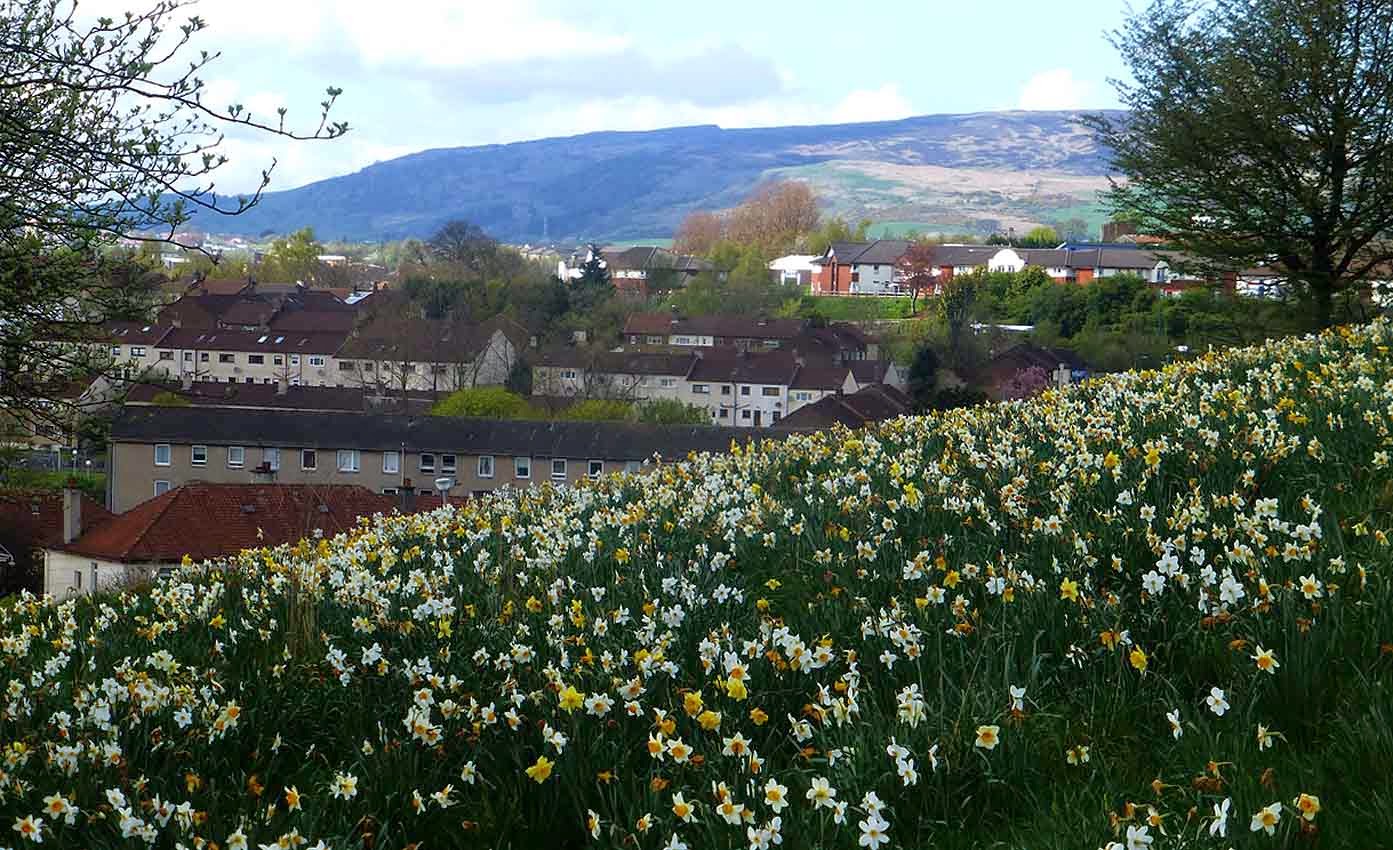
And finally.... a view over Knightswood to the Kilpatrick Hills.
This is also a homage to Louise Brooks as there is a new biography out about her, she came to prominence during the roaring twenties when Knightswood was being constructed, and she fits in nicely with the era, to my mind at least, as I discovered the silent attraction of her films here as bees buzzed outside in the foxglove grove and my young heart thumped faster with the thrill of a new experience. Who knew silent film could be so rewarding.
Dancer, showgirl, model, hard drinking actress, writer and a practical and practiced courtesan she still seems to sum up the dark allure of early Hollywood in one 5' 2" package of attitude, razor sharp quotes and world weary cynicism. Unlike many of the silent film stars she is still a relevant style icon to this day as her contemporary look and appeal have never dated. Films, music and the fashion industry have used her as an inspiration for decades. Think this is not the case?
Liza Minnelli in Cabaret is pure Louise Brooks.... as is Catherine Zeta Jones in Chicago. Natalie Portman in Leon and even Hit Girl in Kick Ass is a mini purple haired sly version of her outlook and attitude to life.
"I have a gift for enraging people but if I ever bore you it will be with a knife." is one of her many memorable tongue in cheek edgy quotes. A 'flapper girl' that could out flap the surrounding pack.
Pandora's box for me opened its curtains in leafy Knightswood for the first time.
Sexually abused as a young child by the kind of neighbourhood opportunist that exists in all communities she was the archetypical "bad girl" in real life and in film, leaving home at sixteen already wise to the ways of men which would be an advantage for the type of roles she would play later. The hypocritical and contrary nature of society and humans in general often creates its worst monsters but Louise was as much a victim of her upbringing as a sinner in later life.
Sydney Bechet was a talented jazz saxophonist, multi instrumentalist and composer with a forceful and at times highly improvised style that had many admirers but he also had a suspect temperament and had done jail time for pulling a gun on someone who suggested he was playing the wrong chord.
Maurice Chevalier was a popular French actor, singer and star of Hollywood films who could actually speak perfect English with an American accent in normal life but was destined to play his token foreigner persona throughout his career. A fact that must have annoyed him at times despite paying the bills.
Hollywood has always attracted those looking for a substitute family, easy wealth, a hedonist lifestyle, the lost, damaged, feisty, fame and bright lights addicted or just plain crazy individuals. It's a temple of often trampled but ambitious people who have been moulded by harsh events in many instances and these Queens of the Jazz Age were no different in their mirrored kingdom of deep seated issues, insecurities, back stabbing, broken dreams and promises dating right back to Sodom and Gomorrah. A dance as old as humanity itself....but one with sparkle. The Dark Allure of Hollywood that has burned many a pretty moth in its flame.